Sunday, June 29, 2014

No Taming This River

(Preached at the Historic Methodist Campgrounds of Des Plaines, June 29, 2014.)

When the poor and needy seek water, and there is none, and their tongue is parched with thirst,I the Lord will answer them, I the God of Israel will not forsake them.I will open rivers on the bare heights, and fountains in the midst of the valleys;I will make the wilderness a pool of water, and the dry land springs of water.I will put in the wilderness the cedar, the acacia, the myrtle, and the olive;I will set in the desert the cypress, the plane and the pine together,so that all may see and know, all may consider and understand,that the hand of the Lord has done this, the Holy One of Israel has created it.

-         Isaiah 41:17-20

Then the angel showed me the river of the water of life, bright as crystal, flowing from the throne of God and of the Lamb through the middle of the street of the city. On either side of the river is the tree of life with its twelve kinds of fruit, producing its fruit each month; and the leaves of the tree are for the healing of the nations. Nothing accursed will be found there any more. But the throne of God and of the Lamb will be in it, and God’s servants will worship God; they will see God’s face, and God’s name will be on their foreheads.  And there will be no more night; they need no light of lamp or sun, for the Lord God will be their light, and they will reign forever and ever.
-         Revelation 22:1-5

These passages—the one from Isaiah 41 and the other from Revelation 22—are pretty special to me. They were both read at my wedding, which occurred only four weeks ago. I know, I know—not traditional wedding scriptures. No 1 Corinthians 13 of “love is patient/love is kind” fame or 1 John 4, which declares that God is love. It’s not even the wedding at Cana, which is recounted in the beginning of the gospel of John, but that one would have been weird at my completely dry wedding. Nope. My wife, Kacie, and I chose some prophecy for our wedding.

The Susquehanna River in the background
of the Fort Hunter lawn where Kacie and I
were married. (Photo credit Doug Austin)
Ok, so we didn’t really choose these passages for their prophetic prowess, though it’s pretty cool, too. We figured out our wedding scripture by looking around us when we did our site visit at a country park called Fort Hunter, just north of Harrisburg, Pennsylvania. See, we got married on the lawn between the old Victorian mansion of the park and the Susquehanna River. It was the river that inspired us. I grew up beside that river—the mighty Susquehanna, which divides the state of Pennsylvania between east and west (and Eagles and Steelers, if you follow football) and upon which no boat bigger than a flat-bottom motor boat can travel. It starts somewhere up in the hills of New York and then cuts through the Northern Tier and coal country, going past my little one-traffic light hometown (which is one more traffic light that it had when I was living there), surrounding the Three Mile Island nuclear power plant, which nearly blew up in the late 1970’s, and finally empties into the Chesapeake Bay down by Annapolis, Maryland. It’s a beautiful river, even if it’s not particularly useful for shipping like the rivers of the Midwest. It also passes Lewisburg, the town where my overeager Methodists in central PA like to think Robert Lowry wrote the hymn “Shall We Gather at the River”—he did have a house there after all. Too bad Lowry was Baptist  and actually wrote the song with different lyrics about a church in Brooklyn. It’s nice story, though, and it’s a nice river, too.
But I’ve seen the Susquehanna show its untamed side, too. In 1996 after hard winter with a blizzard or two, the high river and its ice took down a span of the Walnut Street Bridge in Harrisburg. In my senior year of high school the remnant of an Atlantic hurricane whipped up the river until there was 6 feet of water in the square of my hometown. I recall folks fishing there, where cars usually parked to pick up their pizza at Zeiderelli’s, though I hope they didn’t eat whatever they caught, considering the sewage treatment plant was less than a hundred yards away. Then again, maybe that’s why Zeiderelli’s had a limited-time-only small-mouth bass pizza that autumn. Hmm…
There’s no taming rivers, really. There’s always been that tension about rivers, and water in general. Get too much, you’re knockin’ on Noah’s door. Get too little, you join Ezekiel’s valley of dry bones. Of course, all the great civilizations of the ancient world—the ones that started building their cities 20,000 years ago—were by great river systems. Egypt had the Nile. The Chinese had the Yangtze and Yellow rivers. Mesopotamia in the Middle East was the land “between the rivers.” The rivers brought not only the water which no human can live without but also the rich silt of dirt that accumulated as it flowed inexorably down-hill. In fact, many of these civilizations were successful at early agriculture because their rivers regularly flooded and renewed the soil with its floodwaters. Maybe that is to say that untamed flooding isn’t all bad.
However I know that you all have a pretty tense relationship with your river, too. You already know that there’s no taming this river. The mighty Des Plaines River has left its mark on your little civilization here at the Historic Methodist Campgrounds. I remember when I first came here last summer. The mud was mostly dry, but it was still visible in the grass and on many of the cottages. I understand many of you have been in the process of putting your cottages on stilts, and I understand that some of you didn’t make those stilts high enough for those untamed Des Plaines River floodwaters. I understand that these floods were supposed to be hundred-year floods, and they occurred twice in 5 years. Still, let’s praise God that we can meet in this tabernacle of the Lord without floating around in anchored dinghies. I’m confident that God would meet us nonetheless, but I’m glad that God has kept the ground here dry, at least for today.
What do we make of these untamed floods? How do we understand these watermarks five feet above where we stand or sit now? And if God is the omnipotent, omnipresent, and omni-benelovent God that some our doctrine declares God to be (hope you don’t mind me getting theological in here), what does it mean that God doesn’t tame these floods? My seminary professors say that these are issues of theodicy, coming from the Greek theo, which means God, and diche, which means justice. So we are treading in the untamed waters of God’s justice now, and the water looks as murky as the Des Plaines river floodwaters.
Pat Robertson, that sage of the 700 Club who told New Orleans and Haiti that their natural disasters were because of their deals with the devil, might say that these floodwaters are sent directly from God to punish unrepentant sinners. Then again, Pat Robertson also recently said that tattoos were worthy only of heathen. If Pat Robertson is consistently right, then you have word of God coming to you from a heathen today. Well, I was taught to respect my elders, but I don’t respect Pat Robertson’s theology. I don’t respect Pat Robertson’s theology because, as some of my African American colleagues would say, the Lord God Almighty is no respecter of persons. That is, God will work good things in us and through us flawed humans despite our sin. That is, God will take the weakest parts and honor them the most. That is, God will redeem even the greatest sinners, like maybe some Roman soldiers whose job it was to crucify uppity Palestinian Jews, and transform their most terrible instrument of humiliation and death, like maybe some old rugged cross from the reign of Emperor Tiberius, and make the most glorious symbol of victory, justification, and grace in the history of creation. Let’s give God some praise for God’s untamed river of redeeming grace!
Now I love praising God. It’s one of my most favorite things to do, whether it’s an old Charles Wesley hymn like “O for a Thousand Tongues to Sing”, or it’s an African American spiritual like “Go Down Moses”, or it’s some praise chorus fresh off the pen of David Crowder. Coming together to praise God is so good, we can rise up from these murky floodwaters into that third heaven that Paul visited long ago. I’ve heard experiences like that called “mountaintop” or “burning bush” moments, and if you haven’t experienced one yet, I pray that you will, because it is so good. Fresher than the freshest spring, sweeter than the sweetest honey, warmer than the warmest sunlight. Hallelujah!
Here’s the thing: we don’t spend all our lives in the third heaven. In fact, we’re really, really lucky if we get to spend even one nanosecond up there. No, dear friends, we spend nearly all of our earthly time here on earth, often stuck in the mud or trapped in floodwaters. So, to repeat an earlier question, where’s God’s justice in the floodwaters of this untamed river?
Let me drop a bomb on you now that sends a shockwave more powerful than any thermonuclear warhead our military or any other military can hope to build. God’s justice is not our justice. You might be shell-shocked now, so let me repeat that. God’s justice is not our justice. Just to make sure it’s getting through that Lake Michigan fog, say it with me: “God’s justice is not our justice.” No! It’s not! And let’s praise God for that! God’s ways are not our ways, and God’s justice is not our justice. God doesn’t throw away black and brown and poor folks into jail for profit or for election-day boasting. God doesn’t sentence minors to a lifetime of prison rot. God doesn’t execute folks whose innocence would be proven with just a little more effort. No, dear friends, God’s justice is not our justice, praise God! Hallelujah!
See, dear friends, God’s justice does actually flood us. God says, “Let justice roll down like waters, and righteousness like an ever-flowing stream.” Yes! Maybe God’s justice really is in those untamed Des Plaines River floodwaters, just not the way Pat Robertson thinks. See, God doesn’t want us to suffer, and God doesn’t make us suffer. Why would God want to do that when we humans are so good at making our own sinful selves suffer? No, God’s not in the suffering business, but God IS in the redemption business and the repentance business.
When our Lord and Savior Jesus Christ started his ministry in northern Palestine 2,000 years ago, he said, “Repent! For the reign of God has come near.” That word for repent is the Greek metanoia, which more precisely translated means to “re-orient” or “re-center”. It’s like when we’re caught in water over our heads, and we get off course. When I was in Boy Scouts, we always started summer camp with a swim test. I was always finished the test strongly, but I was always swimming off course for whatever reason. I always felt bad for the Boy Scout swimming next to me because he was in danger of me strongly swimming directly into him. I needed somebody to “re-orient” me so I could finish the test. I needed to repent of my wrong course so I could get to the place where I needed to go. That’s what repentance is about.
Dear friends, maybe the floor under our feet is dry today, but let’s confess that we are awash in the floodwaters of sin. We need to repent. Yesterday marked the 45th anniversary of the Stonewall Riots which took place in West Greenwich Village of New York City, and today a million people are gathering on the North Side of Chicago for what is known as the Pride Parade. Maybe you don’t like some things that are part of the Pride Parade, but you probably don’t like some things in the Bible, too. If you think that you do like everything in the Bible, then I challenge you to read the Bible more closely. Then I challenge to check out Pride again. Because the men and women of Pride know some stuff about repentance. They know what it’s like to repent of the isolation and shame and endless bullying that they suffered for years. The real question is when will the rest of us repent of our idolatry of the white, heterosexual man who has the body of an underwear model and the bank account of a hedge fund manager. When we repent of our sinful idolatries and truly worship God the way God calls us to—that is, by doing justice, loving mercy, and walking humbly with God—then maybe we too can celebrate the new heavens and new earth that God has prepared for us through Christ’s life, death, and resurrection.
So even when we are in the midst of murky floodwaters, let us praise God for justice that cuts through the clouds like a ray of sunshine. Let us praise God for throwing us a life preserver was the river rages around us. And let us even praise God for that lovely untamed river of the water of life, bright as crystal, flowing untamed from the throne of God and of the Lamb through the middle of North Halsted Street in the city of Chicago. On either side of this untamed river is the tree of life with its twelve kinds of fruit, producing its fruit each month, but especially at the end of each June; and the leaves of the tree are for the healing of the nations, but especially for these United States of America. Nothing accursed will be found there in Chicago any more. But the throne of God and of the Lamb will be in Chicago, and God’s servants will worship our most gracious and loving God; they will see God’s face, and God’s name, “I am what I am,” will be on their foreheads.  And there will be no more night where innocent people get beaten up just for being who they are; they need no light of lamp or sun, for the Lord God will be their light, and they will reign forever and ever.

May it be so. Amen.

Monday, May 26, 2014

Act. Reflect. Repeat.

Preached at First United Methodist Church at the Chicago Temple on May 24, 2014 on Acts 17:22-34.

I have a confession to make, First United Methodist Church at the Chicago Temple. I’ve been cheating on you with another internship. No, no, let me finish. It gets worse. My other internship is with a campus ministry…sponsored by the Episcopalians. And the Lutherans. Yes! There it is, out in the open. Let me explain…
             I’ve been on staff at South Loop CampusMinistry since early 2013, and it’s been an exhilarating roller coaster ever since then. See, the pastor of First Trinity Lutheran Church on the South Side started working as the official campus pastor in 2012, and he offered me, a professing Methodist, a job. I’d been attending his church for a couple years, and I figured that if someone would pay me to work with college kids, I better take the offer. The thing is that Pastor Tom needed some help. See, one program he had started was a free community meal on Sunday nights at Grace Place Episcopal Church. I guess Pastor Tom remembered his days as a college student and figured that if you cook it, they will come. Well, they came, but they happened to be homeless folks from the South Loop and not students. Somehow he didn’t see that one coming.
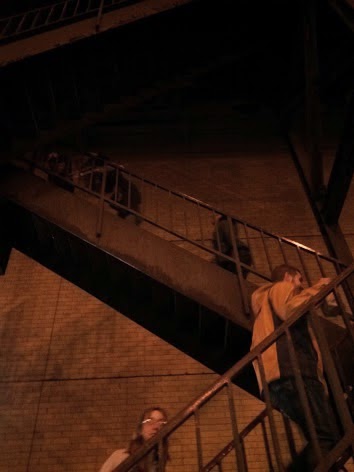
            Instead of casting out the homeless folks, he had dinner with them. It was small group, and one night
Takin' it the stairwells at Lower Michigan
with South Loop Campus Ministry.
they had so much food left over that he and a few other people packaged the leftovers into plastic bags and wandered into the streets to see if anyone would take food from a plastic bag being carried by strangers. The answer to that quandary is yes, and that’s how SLCM’s “Takin’ to the Streets” program began. We still have free community meals at Grace Place, but now we only do them on the last Sunday of the month. We focus a lot more on preparing 60 bagged lunches of peanut butter and jelly sandwiches, a piece of fruit, a small bag of chips, and a doughnut from a friendly local bakery. We walk with a couple carts overflowing with paper bags up State Street and then down to Lower Wacker and back, offering food to anyone we encounter along the way.
            Then, when we get back from our 2 mile journey through the Loop, all the time looking for the people that society tries to ignore, we get to the really exciting part. We evaluate our experience. We borrow our evaluation structure from community organizing, and we do it in three parts. In the first part, each person shares one word that sums up what that person is feeling after the evening’s experiences, after which we open discussion for unpacking people’s words. The second part is what we call points of tension. When did you feel tense throughout the night? It’s very rare that a Sunday evening passes without some tension. I mean, really, just wandering into that subterranean mess of streets beneath the Loop is enough to put your stomach in a knot. We call the last part our “theological learning”, which corresponds with community organizing’s “political learning” which ends most meetings. Theological learning means anything you learned about God, faith, or even humanity, because we recognize that some people aren’t well practiced in looking for God. Then we pray.
            So let me recap this program for you. We act. We reflect. Then we repeat.
            This action-reflection model is called “praxis” in some academic circles, and it’s how we do theology at SLCM. It is also, historically speaking, how we do theology as Methodists. A lot of scholars have called John Wesley a praxis theologian, and that’s why the United Methodist Book of Discipline, our official church rule book, has “a theological task” instead of a distinct confession or catechism. Methodists act, then reflect on what we just did, and then we repeat, only a little more perfectly or holier than the previous time.
            So in the spirit of praxis, I really want to join the Athenians in heckling Paul. Maybe not for the same reasons as the rest of the crowd in Athens, but dude, Paul, can’t you see that your speech just didn’t work? Let me set the scene a little bit more. Paul has been traveling around the Aegean Sea to different cities proclaiming the lordship and resurrection of Jesus Christ, and he’s been getting into a lot of trouble for it. The keepers of first century civil society keep putting him and his comrades in prison to stop his blaspheming against the emperor in Rome—or at least to stop bothering people in the marketplace. In fact, Paul’s hosts in Beroea sent him to Athens because his own people, the Jews, were going to politely ask him to shut up before they impolitely shut him up.
            Now Athens was a different kind of town than the other places Paul had visited. It was a college town, and it attracted people who liked to learn for the sake of learning. Basically, Paul had been in the South Shore, and his friends gave him bus pass to Hyde Park. The Athenians at this point were an open-minded, academically-inclined bunch. Sure, they had forcibly poisoned Socrates a couple hundred years earlier, but they had matured since then. They even had a place called the “Areopagus” for crazy religious fanatics to entertain them. You know, crazy folks like Paul. So Paul got into Athens, did his Jesus thing, and the open-minded Athenians said, “Hm! This guy seems crazy to us. He would be perfect for the Areopagus. Let’s give him a soap box and let him go to town.” And so Paul did, and the Athenians politely humored him, at least until Paul started talking about how they would be judged by a man whom God has appointed and resurrected. That’s when the less polite Athenians, probably the ones who were only there for the extra credit for their religious studies class, started heckling him. Some were polite, but Paul had had enough of this over-educated crowd and left. Clearly Paul had not gone to the same evangelism workshops that I’ve gone to.
            Then again, maybe any critique I have of Paul’s performance at the Areopagus is really about my hang-ups with Christian evangelism and not about Paul at all. I grew up in rural, central Pennsylvania as a very active member of my little United Methodist church in Marysville, and I became quite evangelical by the time I was a teenager. I even once turned down a romantic relationship by using the excuse that I wanted to focus more on a revival in my high school. Yes, I was one of those people. I continued in my holy rolling ways during my freshman year of college in dormitory hall of drunks, potheads, and other inhibition-less people. By my second semester, I was ready to start witnessing to them. I had a pretty good relationship with one atheist engineer two doors down—his name was James—and I got my opportunity to witness to him one night while I was on crutches and I had his sympathy. We went to the cafeteria for a late supper, and I started questioning him about why he didn’t believe in God. And you know what? My hallmate didn’t want to talk about his atheism. Drats! Foiled again! I kept trying to bring up the subject again, but all James wanted to talk about was how difficult it was to maintain a long-distance relationship with his girlfriend. Girlfriend, shmirlfriend, James. Don’t you know that your soul is in peril? Flee from the wrath that is to come, James! Fleeeee!
            I had my evangelical Christian agenda, and it was not meeting my hallmate’s need for care and support that night. James didn’t need an evangelist. He needed a friend, and I wasn’t being a very good friend. I was lucky that a year later when my somewhat long-distance relationship fell apart, I did have good friends who were willing to give me the love and support I needed. In the middle of a deep, dark depression my friends brought me bit by bit back into the light. They were witnessing to me through their actions of care and love and support. They were preaching the good news to me.
            You know, Paul got this kind of good news once, too. Not the proclamation kind, but the knock-you-on-your-keister-and-accept-help kind. Back when Paul was still known as Saul and was holy rolling his way through Judea, putting Christians in prison and generally being a jerk, Jesus came and literally knocked him on his keister on the road to Damascus.
            I don’t think Jesus gave Paul all the instructions that he gave his disciples the night before his crucifixion, but Jesus still got the point across. “They who have my commandments and keep them are those who love me; and those who love me will be loved by my Father, and I will love them and reveal myself to them.” That’s one of the things Jesus told his disciples in the upper room that night long before Jesus revealed himself to Paul. “They who have my commandments and keep them…” Jesus only really gave one commandment that night to his disciples: “Just as I have loved you, you also ought to love one another.”
            Love one another. Maybe Paul received some tough love on the road to Damascus, but he got the more caring, supportive kind of love from the Christians in Damascus. They housed him and fed him and cared for him while he was sorting out his life. Even though this guy, still known as Saul, had a record of Christian’s lives living hell, they still loved him. Paul witnessed the good news through the loving action of that Christian community in Damascus, and so he witnessed Christ among them. That love brought Paul out of the darkness and bit by bit back into the light.
            One maxim I’ve learned about preaching is to avoid preaching what I don’t know. I shouldn’t try to make gleaming metaphors about astrophysics and faith because I barely passed my behavioral statistics class. I’ll leave the astrophysics to my dear friend Elizabeth who is getting her PhD in that field, and who was a great friend when I needed one after a certain nasty breakup. So I’ll leave astrophysics to her. I can, however, preach about love because I have witnessed an awful lot of love. I have witnessed love in the support that my family and friends give me even when I act like a knucklehead. I have witnessed love in how a little Lutheran church on the South Side welcomed me as a Methodist missionary and let me live in their former parsonage for nearly four years. I have witnessed love in how my fiancée, Kacie (who will be my wife in one week), is okay with me preaching tonight even when we still have SO much to do between now and our wedding.
            I have witnessed love among you, too, First United Methodist. I have witnessed love in how you help each other out when in hard times, like when someone’s mother dies or when finances are running really low. I have witnessed love when you not only provide a free breakfast for homeless guests on Saturday mornings but also when you cross lines of economic class and really listen to someone’s story. And I am witnessing love as you struggle with how to care-fully, that is, full of care, host marriages of same-gender-loving people in your building. These are acts of love, and they preach volumes about who God really is.
            Friends, we can love because God first loved us. That love very often comes through the actions of other people, but it is God’s love, nonetheless. This is God’s righteous action—to love us. As my boss at the campus ministry, Pastor Tom, likes to say, “There is nothing we can do to make God love us—me, you, and everybody else—more. And there is nothing we can do to make God love us less. God just loves us. Period.” Whether you experience that love on a mountaintop or on Lower Wacker, it’s still God’s love. God meets us wherever we are, however we are, because God just loves us.
            I think that’s what Paul was getting at while he was on his soap box at the Areopagus. He was just doing his best to witness to the love he had received from God through a faithful community of Christians. Maybe he would have done better to just get out of the way and let God love some people, but God loved the Athenians anyway. I know I would have done better back in college if I had gotten out of the way and let God love my hallmate, James, but God loved James anyway. It’s just what God does. It’s just how God acts.
            God acts. Yeah, God acts. Then we reflect. That’s what I’m really doing right now. I am reflecting on how God acts. That’s what we really do when we gather to worship. We reflect on God’s holy, righteous, and loving action. That’s what we’re really doing tonight. It’s good. It’s really good. Let’s keep doing it.
            Act. Reflect. Repeat.

Thursday, April 24, 2014

The Resurrection and the Struggle

The same night he got up and took his two wives, his two maids, and his eleven children, and crossed the ford of the Jabbok. He took them and sent them across the stream, and likewise everything that he had. Jacob was left alone; and a man wrestled with him until daybreak. When the man saw that he did not prevail against Jacob, he struck him on the hip socket; and Jacob’s hip was put out of joint as he wrestled with him. Then he said, ‘Let me go, for the day is breaking.’ But Jacob said, ‘I will not let you go, unless you bless me.’ So he said to him, ‘What is your name?’ And he said, ‘Jacob.’ Then the man said, ‘You shall no longer be called Jacob, but Israel, for you have striven with God and with humans, and have prevailed.’ Then Jacob asked him, ‘Please tell me your name.’ But he said, ‘Why is it that you ask my name?’ And there he blessed him. So Jacob called the place Peniel, saying, ‘For I have seen God face to face, and yet my life is preserved.’ The sun rose upon him as he passed Penuel, limping because of his hip. Therefore to this day the Israelites do not eat the thigh muscle that is on the hip socket, because he struck Jacob on the hip socket at the thigh muscle.
-          Gen. 32:22-32

Resurrection happens when you least expect it, where you’re least likely to look, to the person you’re most likely to ignore.

Like when everybody’s gone away, and the sun is setting on the banks of the River Jabbok, to that exile, that wanderer, that trickster, that heel of a person we know as Jacob. Really—that’s what his means.

Jacob isn’t somebody I want to like. He was never the once and future quarterback of the championship football team; that’s his brother Esau. Jacob gets what he wants through trickery, through withholding food to the hungry, through dressing up as someone else and fooling an old, blind man. And then when his sins catch up with him, he runs away.

Jacob’s trickster nature follows him in exile. He manages to seduce Rachel, Laban’s daughter, but then somehow ends up marrying both of Laban’s daughters. And then he has sex with not only both of them, but also several of his maids. That’s not even why Laban eventually evicts Jacob. That happens because Jacob has been tampering with his father-in-law’s herds of cattle. And then Jacob runs away again.

That’s when Jacob gets word that his estranged brother, whose last words directed to Jacob were “I’m gonna kill him first chance I get!”, is looking for him. With 400 other guys whom Jacob assumes want nothing more than to take turns hitting something.

And what does Jacob do? He sends all of his family to the other side of the River Jabbok where Esau and his bloodthirsty band of brass knuckles are waiting for him. Like I said—I don’t want to like Jacob.

Maybe I don’t want to like Jacob because his story reminds me of my own character defects. Jacob’s story reminds me of all the times that I have struggled—struggled with my own identity and purpose, struggled with my relationships with other people, and struggled with God.

So where is the resurrection in this story? Well, let’s have a look at Jacob when the sun comes up. Jacob is visibly limping. He answers to a new name. And he confronts the demons of his past with the confidence of someone who has experienced true, life-altering blessing.

Jacob had experienced resurrection, resurrection through struggling with God.

Funerals are another place where we don’t expect resurrection.  Loved ones gather to share in their grief and their loss, to give their last good-byes to a corpse that is as empty as a deflated balloon.

And yet we often call funerals services of death and resurrection. We often refer to John chapter 11 where Jesus declares that he is the resurrection and the life. And then we pray “Requiem aerternum dona eis Domine”—“Grant them eternal rest, Lord our God.”

But rest isn’t the intention of resurrection. The purpose of resurrection is life, yes, even life abundant! And what is life but struggle—struggle with the world, struggle with all the wicked and wonderful people that inhabit it, struggle with God, great God Almighty, Dominus Deus Sabaoth!

God is the resurrection and the life. God is the resurrection and the struggle.

The struggle! Yes, sisters and brothers, God is the struggle, or as our Spanish-speaking sisters and brothers call it, la lucha. I’ve heard my Spanish-speaking sisters and brother talk a lot about la lucha since I decided to join them in solidarity with la lucha. “¡Viva la lucha!” they shout at rallies, and I’ve gotta tell you, sisters and brothers, Anglos like me should listen to them. White folks like me should listen to our sisters and brother from the global South because they know an awful lot about la lucha and resurrection.

My Metodistas de BsAs
I learned about la lucha and resurrection when I had the blessing to study in Argentina while I was an undergrad. I’m tempted to say that it was another one of those unlikely times and places where resurrection occurred. Some young people in the little Methodist church in downtown Buenos Aires graciously accepted me into their clique, and then began educating me in the ways of the la lucha. My friends invited me to march with them in the Veinti-cuatro de Marzo parade, that is the twenty-fourth of March, which marks the anniversary of the last coup-d’état in that country. See, during the military dictatorship that began on March 24, 1976, some 50,000 political dissidents were “disappeared”, many of them young people who were learning to struggle, to be in la lucha, against injustice.

The day ended with a concert by León Gieco, the Bob Dylan figure of Argentina, at the Escuela de Mecánica de la Armada—the Naval Mechanics School—which had served as a center for detention, torture, and execution during the dictatorship. Shortly before the concert began, a branch of the Peronista party, which had been viciously persecuted during the dictatorship, began a rally to remember their fallen comrades. I can still see the flags, banners, and posters lifted high into the air. I can still feel the exuberant bodies of the crowd around me. I can still hear their chants of liberation. The leader would read a name of a disappeared person, and the crowd would shout back, “¡Presente!” As León Gieco sang his most famous song, Solo le Pido a Dios—I Only Ask God—and everyone sang with him, I could feel resurrection around me. And la lucha—the struggle—continued.

A classmate of mine at seminary, Tito, had some thoughts about resurrection during our first semester of classes together. While we were struggling with the concepts of early Christian theology, Tito shared that resurrection was very important for him and his comrades in Latin America, particularly in El Salvador where he had served the victims of the civil war there. He said that resurrection was important because no right-wing death squad, even when armed with best weapons the American government could sell them, could stop a revolution based on resurrection. Such resurrection-minded revolutionaries could cry out like St. Paul, “O death, Where is thy sting? O grave, where is thy victory?” La lucha—the struggle—continues and you, O Death, can’t stop it. You, O Death, can’t beat it. You, O Death, are overcome by the power of the resurrection and the struggle!


Dear friends, witness the power of the God of resurrection! Let the power of resurrection blow apart all of your expectations! Let the power of resurrection touch you and change you forever! Let us say yes to the God of the resurrection! Let us say yes to the God of life! Let us say yes to the God of the struggle! ¡Que viva la lucha! ¡Amén!

[Sermon was preached at First United Methodist Church at the Chicago Temple on April 23, 2014.]

Tuesday, February 18, 2014

Getting away with it

This sermon was shared at First United Methodist Church at the Chicago Temple at the Saturday evening service of Feb. 15, 2014. It used the scripture of Matthew 5:21-37.

Let’s talk about rules. We’re in a Methodist church, right? So tell me, who here is good at following rules? Please raise your hand. Okay, who here is bad at following rules? Please raise your hand. Who here just doesn’t like to raise their hand?
            I’m a guy who actually likes rules. Really, I do! Give me a checklist and I will go down and systematically check those things off the list. You would be amazed at the impressive list of checks on my checklist, were you to check out my impressive list of checks.
            Or even better, instructions. Give me a collection of instructions, and I would probably be able to put Humpty Dumpty back together again. My parents were fairly well convinced that I would be engineer when I grew up. Seems pretty unlikely now, but when I was playing with Legos as a kid—dude, I looked like an engineer. I always had trouble completing a project when I just had one my big bins of jumbled up blocks, gizmos, and dismembered Lego people bodies, but give me step-by-step instructions and I could build anything. I still remember one of my favorite Christmas gifts—a Lego battle droid from Star Wars Episode I. You know, the one with Jar Jar Binks? I spent the afternoon of Christmas Day in my grandparents’ basement following those step-by-step instructions until that 2-foot-tall masterpiece would not only walk but also unholster its ray-gun in one fluid motion. Behold! The power of plastic pieces, some detailed instructions, and one little anti-social 8-year-old.
            As I got older, I learned other kinds of rules and instructions, namely social norms. Those don’t necessarily come easy to a kid who would prefer a dim basement and Lego instructions to actually spending time with my Iowan grandma. But over time, I learned how the world worked. Namely, identify the authority figures, find out what pleases those authority figures, and then subtly fulfill the desires of the authority figures, especially the desires that they don’t explicitly make known. And I was good at that. I suppose I still am.
            But here’s the thing about rules: they’re meant to be broken. At least in America, that’s the common ethic. Break the rules and get away with it. That’s what the smart ones, the cool ones, the fast ones, the successful ones all do. Break, or at least bend, the rules and get away with it. Guy Forsyth, a blues and folk musician from Austin, Texas gets the American ethos: “Everyone wants to pull off the crime of the century—steal two hundred gazillion dollars, enough to buy myself an island and build an honest-to-God train on it for no one but me. And get away with it. Get away with it. We Americans are freedom-loving people and nothing says freedom like getting away with it.”
            Or even more colorfully, there’s the allegory that my dad likes to use. The speed limit allegory of the American spirit: So we have a speed limit of 55 miles an hour. I know that 9 out of 10 cops will let me drive 60 miles an hour and not pull me over. And when there aren’t any cops around, I can go 70. And get away with it.
            Just look at some of most beloved heroes. Huck Finn and Tom Sawyer float on a raft, defying their frazzled families and all that comes of it is one of the more memorable funeral services in American literature. Indiana Jones rescues the Ark of the Covenant and the damsel in distress without ever worrying that his lack of office hours at his tenure university post will adversely affect his evaluations. Harry Potter slinks around in a cloak of invisibility and not only defeats the Dark Lord but embarrasses all the bullies along the way.
            Break the rules. Get away with it. Behold, the great American ethos.
            So what’s up with this gospel lesson? I don’t know about you, but I came to reclaim my Christian faith with a strongly Methodist flavor because Jesus is constantly bending the rules until they break. Jesus hung out with drunks, prostitutes, and racketeers; disrupted orderly worship services by healing outcast lepers; and then embarrassed his snobby hosts by talking religion and politics at the dinner table. That’s counter-cultural Jesus, Jesus de la resistance, Jesus de la revolución! He probably had stylish facial hair, thick-rimmed glasses, and skinny jeans, too.
            But the Jesus of Matthew 5 is giving even more rules. Not that it’s big deal since we’re so good at bending rules, but Jesus is making it really hard to get around these rules. Holding onto anger is akin to murder, ogling equals adultery, and no matter how important your grandmother was to you, don’t swear on her grave. Then there’s the very troubling afterlife of the commandment about divorce. Couple that passage with Paul’s instructions for women at church and at home and we’ve got serious issues. It’s no wonder America, that ever-so Christian nation, is so good at breaking the rules and then getting away with it. What else are we gonna do with ridiculous rules that we can never actually follow?
            That is, if we look at Jesus’ sermon superficially. See, these commandments don’t stand alone in the Gospel of Matthew. They’re part of a much larger Sermon on the Mount. Just before Jesus starts telling his disciples or the multitudes or whoever it is who is sitting on the mountain with him, Jesus tells his congregation that they are the salt of the earth and the light of the world. These are encouraging words, but now Jesus is saying what flavor the salt is enhancing and what exactly the light is illuminating. Then Jesus references the law and the prophets, primarily that he has come to fulfill them and not abolish them. What we get next in these commandments are the parts of the law and prophets that Jesus is flavoring and illuminating.
            And then there’s the cultural context. I could quite easily give four separate sermons for these four commandments if I wanted to delve into the historical criticism of each commandment, six sermons if you include the two next commandments that tonight’s reading did not include but directly follow in the Bible. I know you must be terribly excited now, but I must disappoint you by admitting that I only prepared this one sermon. Suffice to say Jesus was addressing real issues that his listeners were really dealing with back in 1st century Palestine, much like preachers tend to do these days.
            So what is Jesus saying with these commandments if not instructing us in the whiles of litigation, sexuality, marriage, and public speaking? Scholars often call the style that Jesus uses here at antitheses, the plural of antithesis, which is that pattern of “you have heard…but I say”. It was a common rhetorical technique of rabbis of Jesus’ time, who were constantly interpreting and reinterpreting the Torah, the Law of Moses, the rules of Jesus’society. So let’s call Jesus “rabbi” here and recognize how truly counter-cultural Rabbi Jesus ben-Joseph is being when he gives this sermon.
            See, Jesus’ community was full, overflowing really, with inequality, much like today in our communities. There were levels of interlocking oppression ranging from the Roman occupying military to Hellenistic household hierarchies to the laws of the Torah that folks had been abusing for years. Women and poor people were perpetually at the bottom, though there were always inspirational stories of folks who escaped the doom of poverty and made it big. The general rule, however, was that these interlocking rules of state, culture, and religion systematically kept the folks on the bottom from moving up and threatening the status quo. While Jesus couldn’t have been happy about Roman and Hellenistic oppression, he really got mad about the oppression from the Jewish law. Because Jesus was Jewish. Because Jesus was a scholar of the Jewish law. Because Jesus knew that the Law was supposed to free people, not enslave them.
            Any good American might kinda snort, roll her eyes, and say, “So what?  Just be creative and break the rules. Get around them and get away with it.” But when we bend the rules until they break, we are admitting that the rules aren’t doing what they were meant to do. It seems a little self-evident. We break the rules we don’t like. We get around the rules because they do not lead us to fuller, more abundant life, so we break the rules and hope to get away with it. However, getting away with it abandons our responsibility to the multitudes who are trapped in the mire. Getting away with it assumes an ethic similar to the ancient ethic of Cain, that when someone asks us where our sister or brother is, we respond, “How should I know? Am I my sister or brother’s keeper?”
            Let’s think about that for just a bit. What happens when we abandon our responsibility to care for our fellow children of God? What happens when we focus on getting away with it instead of getting it right? Maybe we’ve seen a lesson in the country of Sweden where a judge recently ruled that a rapist can only commit rape if the rapist believed that the rapist was raping. According to court testimony the survivor of the sexual assault told her rapist to stop time and time and time again, but that he didn’t believe her. The rapist testified that he knew she really wanted to be raped. So he should get away with it.
            Maybe we see lessons in news coming from the tribal areas of Afghanistan and Pakistan when American missile strikes kill children. Unmanned drones deliver smart bombs with surgical precision, so innocent people who die in these strikes just happen to be in the wrong place at the wrong time. Besides, everyone knows that you shouldn’t be hanging around the wrong kinds of people. So our military should get away with it.
            Maybe we see lessons in our own state capital when legions of lobbyist, working in concert with armies of accountants, make sure that 2/3 of publically tradedcorporations pay nothing in state tax. Never mind that we have to close schools, cut pensions, and forcibly tighten the belts of the already hungry. We have to make sure that businesses keep jobs here in Illinois, whatever the cost. So multi-billion-dollar corporations get away with it.
            What have we done? Listen! The blood of our sisters and brothers is crying out from the ground! Even if we did not give that cruelest cut, we have not cared for our neighbor the way we ought to. This is confession time, and it’s good for the soul.
            This is why Jesus broadens the rules so that it’s so hard to get around them and get away with it. While some of the rules in the Torah don’t seem to apply to 21st century America, there are others that can preach volumes in not only this pulpit but from the middle of Daley Plaza as well. Yes, I know there are weird rules about avoiding hoopoes for dinner and things of that sort, and my youth group had a great time laughing about it. However, the books of especially Leviticus and Deuteronomy also command that farms and eating establishment not throw away all their left-over food so that poor people can eat good food.  The Torah commands that we treat immigrants with respect and dignity because we were all once immigrants, too. The Torah commands that every seven years debts must be canceled so that people remain equal and in right relationship with one another. The Torah is a blessing to God’s people so that God’s people may be a blessing to the world.
            Jesus doesn’t want us to just get away with breaking the rules, even bad rules, because these are kingdom rules, where the Lord our God reigns with wisdom and justice. Or even better, Jesus is highlighting kin-dom rules, where God is gathering her children back to her as a hen gathers her brood. Instead of seeking to use rules like a cop might use a nightstick, these kin-dom rules remind us that we have a common divine parent and we must care for our family.
            These kin-dom rules have echoed throughout the history of the church, and different leaders have emerged to preach them from the public square when we started to care more about getting away with than getting it right. St. Francis said preach the gospel always and when necessary, use words. Martin Luther preached the priesthood of all believers. The Methodist movement’s own John Wesley declared that there is no religion but social religion, and John Wesley knew some things about rules.
            I know that there are times when we need to break rules because some rules are simply unjust. However, when we know the kin-dom rules by heart (not necessarily memorized, but know them by heart), we realize that we can no longer hope to break the rules and get away with it. We have to care for our sisters and brothers along the way. That’s what Harriet Tubman did. She broke the rules time and time again by guiding African-descended slaves from the South to free land that is just across the Ohio River. She was not following a self-serving, ego-aggrandizing ethic of simply “getting away with it” but knew the kin-dom rules so well that she could see that the other slaves were indeed her own kin, her own sisters and brothers.
            And that was why folks called Harriet Tubman “Moses”. Harriet Tubman followed a higher rule and sent her people across the Ohio River like Moses sent his people across the Jordan River. Harriet Tubman knew the kin-dom rules and would follow them wherever they took her. And so the words of Moses continue to echo through to us today through the redeeming power of Jesus Christ who took the care to sit down talk about the rules with us. The words call from not only the mountain and the pulpit but also the streets which shall be restored so that children can live and play in them again. The words will echo in springs and river valleys flowing with clean water, purified of the taint of greed. The words will echo even in the dark places as sisters and brother reclaim their kin from the shadows of addiction and exploitation.
            And those words will echo throughout all the neighborhoods, all the cities, all the suburbs and small towns, throughout all the nations where disciples grow knowing these kin-dom rules by heart. And those words will be: See, I have put before you today life and prosperity, death and adversity…Choose life that you and your descendents may live, loving the Lord your God, obeying God, and holding fast to God.”
            So dear friends, let’s put away our petty desire to get around the rules and get away with it. Let’s get to know God’s kin-dom rules by heart, get to know who our kin, our sisters and brothers, really are, and then, and only then, can we get to know what it is to truly choose life.

Amen.

Tuesday, December 24, 2013

The Baby of the Star

The following poem was written by Tim Muckian, a volunteer with the Takin’ It to the Streets program of South Loop Campus Ministry. He usually stays at the Pacific Garden Mission on the Near South Side. Tim is a member at Grace Place Episcopal Church, where SLCM hosts the Takin’ It the Streets program, and he always brightens the mood with his off-color jokes and proudly Irish heritage. Tim has been writing poems for Christmas for a number of years, and this is the one for this year. Many thanks are do due to him for sharing this with all of us.


The Baby of the Star
Christmas time is almost here
A day we all hold so dear.

Three wise men traveled every so far
To find the baby of the star.

They found the baby while at rest
Nuzzled to his Mother’s breasts.

She held him close and with such love
Then gave him a kiss, and a tender hug.

Then placed him back where he laid
On a bed made of hay.

Not much of place for a new born King
The ruler of everything.

But all the same he came to be
Part of the Holy Trinity.

He’s the one who loves you most
The Father, Son, and Holy Ghost.

So wherever you come from, and wherever you are
On Christmas Day drop to your knees and pray
For the baby of the star.


By Timothy Joseph Muckian

Friday, December 13, 2013

Season of darkness, season of light

The light shines in the darkness, and the darkness did not overcome it.
-          John 1:5

It’s a dark time of year. It just is, at least this far north. Within a few weeks of the longest night of the year, the shadows seem to creep deeper. The sun seems further away. Slowly but surely the status quo seems to freeze into place.
Lights and dark at the Lincoln Park Zoo makes for an odd, if
bewildering, contrast. 'Tis the season.
            And at most universities, this dark time of year just happens to coincide with the end of the semester.
            Sitting at the cafeteria at Roosevelt University’s Wabash Building, I observed a sort of dry anxiety among students. It’s like they’re too little butter spread over too much bread. Jobs claim many hours to pay tuition and other bills, and classes claim many more hours. Sleep comes in naps between study sessions and take-home finals. A “personal” life seems like a cruel mockery, and the future is even more frightening.
            And oh! The irony of Daley Plaza’s Christmas Village and Lincoln Park Zoo’s winter wonderland.
Wander into Macy’s material maze of festive magic that appeared before the Halloween cobwebs had been put away. Get a cup of coffee while an electronic jazz band contemporizes an Irving Berlin classic. Okay, will you just stop trying to force joy, dammit?!
            We in the Church know these things. We feel them, too. Especially during this season we anxiously look toward an empty crèche, searching for the boy-king who will brighten the darkness with all his Baby Jesus Powers. How long, Lord? How long?
            It feels to me like we’re stuck at the foot of the cross. We’re looking for some miracle on the mountaintop, but all we see is death. Perhaps we forget that the miracle of the resurrection didn’t occur until the darkness was perfect in the sealed grave. We prefer the open air of Calvary to the claustrophobia of the empty tomb. We feel like we have more control if we can just have a visible escape route.
            I’m often surprised that the gospel reading for Christmas Day is the first chapter of John, but within a few weeks of the darkest day of the year, it seems so appropriate. We so desperately need light—in our final exams, in our finances, in our overworked and underappreciated bodies—and we celebrate the light on Christmas.
            This is the message we in the Church have to offer. We call it like it is. We see death around us, we see the darkness, but the darkness did not and does not overcome the light. We’re scared of the dark, too, but our hope is greater than our fear.
            So yes, it’s dark out. All the lights on the Magnificent Mile can’t stop that. However, the light that the darkness cannot overcome doesn’t come from the retailers. The light that truly brightens the dark world doesn’t come from spotless resumes and transcripts. The light to which baptizers testify comes from inside the still, deep darkness of the tomb.
            And then that light—unexpectedly—rolls away the stone.

Tuesday, November 19, 2013

A time to lament

[Presented as part of November, 2011 South Loop Campus Ministry board meeting.]

When the darkness appears
 And the night draws near
And the day is past and gone
At the river I stand, 
guide my feet, hold my hand
Take my hand, precious Lord, lead me home.

Seeming to based on Romans 5:20, this is written on a
wall of a loading dock by Lower Columbus Drive. SLCM
volunteers regularly deliver sandwiches to homeless
folks who sleep there.
I don’t know how long we would have stood there, at the corner of Lower Wacker and Lower Michigan,
with the homeless woman crying and wailing about the cold, about being hungry, about the conditions in the shelters…about so many things. I don’t know how long we would have tried to hold her hand, squeeze her shoulders, pray silently and pray aloud, nod empathetically and stare blankly back at her. I don’t know how long we would have felt helpless to help.
            I don’t know how long we would have been stuck in our not knowing if Thomas, one of our homeless guides, hadn’t tapped me on the shoulder and said, “She’s like this all the time, and now I probably won’t get any sleep tonight. Time to move on.”
            Walter Brueggemann wrote in Prophetic Imagination that lament is a necessary action to break out the paralysis of what he calls the “royal consciousness”, that state of being stuck in whatever state we’re in right now. That status quo always serves the already powerful and always hurts the already hurting. And damn—that woman at the corner of Lower Wacker and Lower Michigan was hurting and lamenting.
            In a much quieter manner students were lamenting up on the 14th floor of Roosevelt University’s Wabash Building where we had set up a Reformation Day door. Students wrote their grievances and their visions for change in the world on pieces of paper and then literally nailed them on the door. People wrote about everything from a living wage for workers to legalization of pot to “some lovin’ for Mexicans”. I don’t know exactly what spurred them to write what they did, but a lot of people liked the action of nailing their “theses” to the door. I suppose it was an avenue to release some of their pent up anguish. I doubt our flimsy door could survive a full release of their anguish.
            Sometimes in ministry pastors can get to thinking that people have such petty problems. Don’t these people know that while they’re whining about their roommates other folks are freezing down by the Chicago River? And don’t get me started on economic inequality…
            Here’s the thing—lament is lament, even if I don’t understand why a certain issue is problematic. If justice is “right relationship”, then injustice must be broken relationship. And that is something to lament.

Kyrie eleison.